Functions
It can precisely control the gas flow rate, ensuring the accuracy of experimental results in experiments with strict requirements. It has good sealing performance, using chemically - resistant rubber seals to prevent gas leakage. It has strong durability, and its material and structural design make it less likely to be damaged during long - term use.
Classification
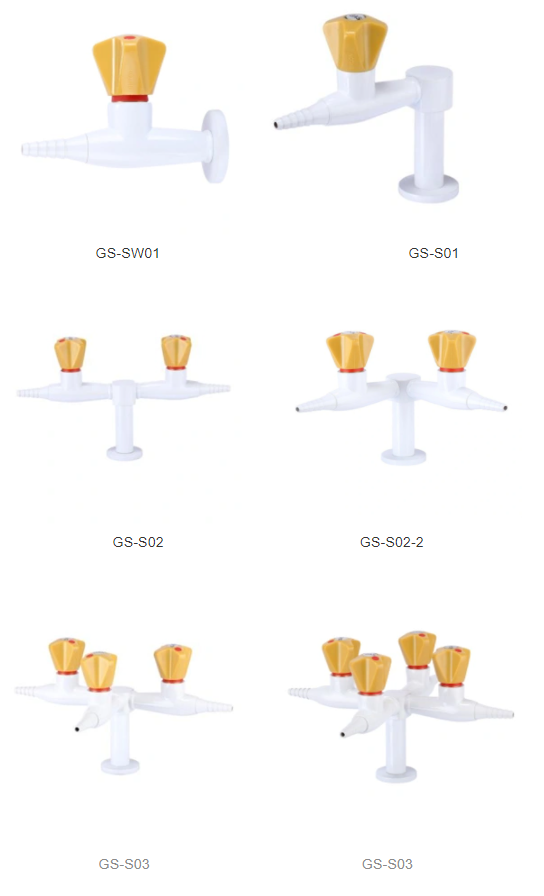
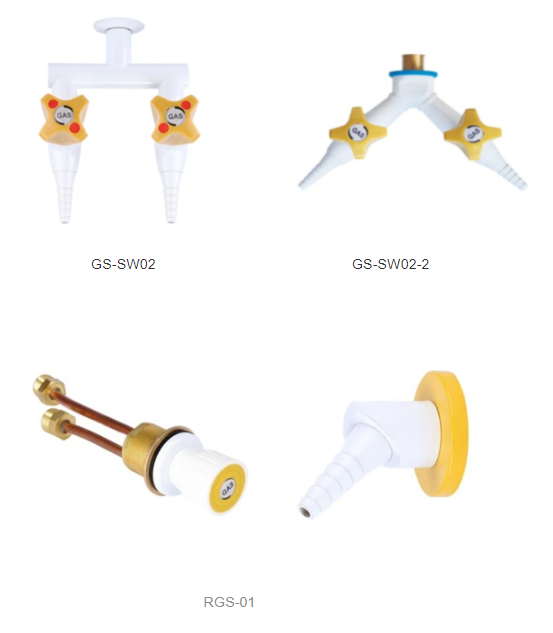
By gas type, it can be classified into air faucets, oxygen faucets, nitrogen faucets, hydrogen faucets, etc. By control method, it can be divided into manual - controlled and automatic - controlled ones. By installation method, it can be classified into wall - mounted, countertop - mounted, and built - in types.
Specification
- Base Material: High - quality brass is selected. It features excellent corrosion resistance and good workability, providing a stable and durable structural foundation for the gas faucet.
- Sealing Components: Nitrile (Nitrile rubber) is used as the sealing material. It has outstanding sealing properties, effectively preventing the penetration of various gases and ensuring the tightness and safety of the gas faucet during operation.
- Lubricant: The lubricant is specifically designed for combustible gases. While ensuring good lubrication, it will not react chemically with combustible gases, ensuring the smooth operation of each component of the gas faucet and the safety of the entire system when transporting combustible gases.
- Flux: The Ag55:Sn alloy flux is employed. This alloy ratio is carefully formulated, endowing the flux with excellent welding performance. During the manufacturing process of the gas faucet, it can ensure that each connection part is firm and reliable, effectively enhancing the overall structural stability.
- Valve Core: A dry - type combustible gas valve core is equipped, which is specifically suitable for conventional low - pressure gas supply systems. This valve core is specially designed and tested to fully meet the stringent requirements for safety and reliability in laboratory environments. It can accurately control the gas flow rate and on - off, providing a stable gas supply for experimental operations. 6. Surface Treatment: The advanced electrostatic powder coating process of epoxy resin is adopted. A uniform and dense protective coating is formed on the surface of the gas faucet, which not only significantly enhances the corrosion resistance of the gas faucet, prolongs its service life, but also gives the product an aesthetic appearance.
- Maximum Working Pressure: The maximum working pressure of this gas faucet can reach 7 bar/100 psi. It can stably withstand relatively high gas pressures and is suitable for a variety of laboratory gas transportation scenarios, meeting the gas pressure requirements of different experiments.